Thursday, November 11, 2010

101026 KIBBUTZ GINOSAR ROCK ARTIST

I. MY FATHER’S BOOK

Yuvi was born and raised at Kibbutz Ginosar on the seashores of the Kinneret along with his four brothers. I recently had the privilege of hearing about a few of their youthful escapades as kibbutzniks and fishermen.
Yuvi is a ‘rock artist’, but not the ‘rock ‘n roll’ kind. His work is out of real stone found in the area. A particular carved stone of his is only one that makes up the Peace Arch as you enter the hotel at Nof Ginosar. He refers to it as ‘the Family Book’. This is one of the stories he related to me:


My father and mother grew up on Kibbutz Ginosar. When they married, a woman gave my mother a pair of white doves which represented their marriage. Everything about our family life is written in the book. (SCULPTED INTO THE STONE: Two doves are engraved into the stone at the top. A book is open and a man and woman are kneeling within it. The photo is of the practice run before the finished product.)
It was very important to my grandfather that everyone spoke Hebrew. Seventy or eighty years ago people did not speak Hebrew in Israel. Jewish immigrants came from Germany, Romania and other places in Europe mostly. They brought books with them in their native tongue or yiddish, so my grandfather wrote a book in Hebrew. He gave it to the people to learn Hebrew so eventually they could communicate in Hebrew.
But when he met with the people, they told him, “We have no money for bread! Why are you bringing us a book?” So he said: “Okay, the book stays here and I will return in two months so we can talk in Hebrew.” Gradually, the people learned Hebrew and slowly more and more people talked together in Hebrew.
This is the story in my grandfather’s book, and that’s why its engraved in the stone of my parents’ lives and is one of the foundation stones in the Peace Arch.

II. MY BROTHER BENI
Yuvi introduces me to his brother Beni who is driving a tractor and playing a harmonica.
Beni is my older brother and he is in charge of everything on the Kibbutz. He takes his harmonica with him all the time to play music. He just came from playing music for the children, and he likes to make people happy.
We like to dance Israeli dances on the Kibbutz and Beni used to play all the different musical instruments at the dances before tapes and CDs came along.
There is an antique tractor displayed on the Kibbutz but the one Beni gets around with on his daily rounds is even more antique.


III. ROCK ARTIST APPRENTICE


ESTI is from Poriya and she is learning to sculpture the rock.
I come every day. I just cannot stop. I told my child I can work here 7-9 hours a day and I don’t feel tired. I don’t need to eat; I don’t want anything. Every night I just wait for the morning to come.I have the freedom to do everything that I want whether I fail or succeed it doesn’t matter.
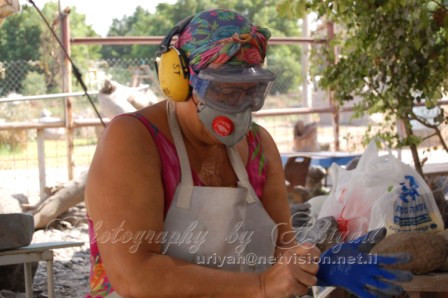
Right now I want to make many butterflies. At first, when I started to make a butterfly, it becomes something else. But that’s what is so magic about the stone. You think you want something and suddenly in the middle the stone tells you a story and it becomes what’s inside.
If someone were to ask me if I’m a ‘stone cutter’, I would say ‘no’ because I’m a writer and artist. I also create from ceramic. And now I can’t leave the stone alone.

IV. ROCK ART AT KIBBUTZ GINOSAR

As a rock artist Yuvi wants to leave behind a legacy of his civilization so that in another 2000 years archeologists will be finding rocks that endured the difficulties and traumas of years between now and then.
He believes there is a story within the rock and when it is handled with care, the rock will reveal its hidden identity. The artist may start out with one idea in mind, but the end product will be something totally different. Every sculpture of Yuvi’s has its own unique personality, and usually has a little humor in its character.

Saturday, October 9, 2010

101008 THE PITSTOP


You get to meet a lot of people at the roadside pitstops which are few and far between in Israel. The Desert Inn is a favorite found on Highway 1, east of Jerusalem called the 'Way to Yericho'.
Children are never bored between the food, playground and camel rides.

Speaking of camel rides! It can be very hilarious to observe parents and grandparents attempt to mount a camel, and even more humorous to watch them ride it. Kids adapt well as the imagination takes them to the place of freedom, riding a camel in the hot desert wind.
But I could certainly understand why the camel would take flight and run into the open dunping the rider into a pile of sand on the desert floor when I heard the alarming squeals of a woman as she shrieked: “Ima-leh! Ima-leh!” I mean give me a break! That would terrify any animal even of the mildest nature! (SAVTA SHOSH from Ramat Gan, with her grand-daughters, Lia & Dolev)

Adults certainly enjoyed the coffee shops and buying those famous Israeli sandals fit for any nomad of the desert, male or female. And of course, who could resist those fresh fruits and veggies at the open stands.

But all too soon, tourists ascended back onto their buses and left for parts unknown. Well, maybe not too soon to please the vendors and the camels who just want a siesta break from the noonday sun.

Monday, September 27, 2010

100927 ANNUAL SPAGHETTI DINNER IN GEMMA'S SUCCAH


Gemma's succah was full and overflowing with friends who came for her annual spaghetti dinner at Succot 2010. One of my demands was for her to sing a few of her childhood favorites which she grew up with.

AUNTIE ALMA

This was Auntie Alma's first time to visit Gemma's succah even though they have been friends for some time. They met at their favorite spa in French Hill, Jerusalem. For her participation in the evening's event, she sang one of her favorite childhood songs.

THIS OLD MAN DAVID BEN REUVEN

David is really not that old but the song he sang is about an old man, Paddy-whack! David brought along his guitar to Gemma's succah and sang a number of songs while everyone else ate all the spaghetti. His music added a little more flavor to the evening and evidently to the food.

Sunday, September 26, 2010

100924 FIRST DAY OF CHOL HAMOED SUCCOT

The first day of Chol Hamoed Succot 5771 was a tremendous success as hundreds made their way up through the Hevron hills to Adurayim for a simcha even though it was a hot day and got hotter.
Families came in buses, loaded vans and private cars as young kids and old kids unloaded the vehicles and hurried to the activities which awaited them. The last remaining building of the abandoned IDF Army base Adurayim may be in need of a lot of cleanup & repair but all this did not deter the crowd of adults who crammed into the meeting room to hear VIP speakers: Rabbi Dov Lior of Kiryat Arba, MK Professor Aryeh Eldad, Yehuda Glick.

Young children gathered to paint a banner of the Temple Mount provided by their dedicated art teacher, Yehudit Eisenberg. Each of them really take serious their part of the painting! I drooled over the banner trying to come up with a plan to get it into my Succah, but in the end I surrendered and let it go to a much larger cause.

The older kids – well, they just went wild over the SUMA wrestling as they battled it out for the place of #1 Suma Victor. Believe me! Suma wrestling can get ‘purty ruff’! Especially, when the battle to be in first place is between brothers.
Everyone in between got plenty of exercise on the inflatable slides, climbing walls and just bouncing in mid-air. But in the end, not only the children who participated were drained of energy, but also those of us looking on. Okay, you go figure.

Balloonists, Elazar Brandt and his wife Krine, worked hard to satisfy the demand for creative & colorful balloon-wear. They kept up with the demand with a little extra help from Rene Morgulis and her daughter Chaya. By the end of the event, they had designed some 300-350 balloons. Satisfied customers proudly donned colorful hats, or waving swords!

Plenty of IDF troops kept close guard over the place full of activities. When Women in Green provide these special events, there is never had a dull moment for the soldiers who keep watch in the hills. They are never bored as the children surround them asking so many questions. The attention of bright smiling little faces or the boldness of adolescents keep them entertained

The Mussa Berlin family struck up the band and put the men into action as they mounted the children on their shoulders and began to dance to the music, ending the event in the true tradition of Simchat Succot.

By the time came to say “l’hitraot” and part company, kids were exhausted, parents were wilted having used up their energy, yet all separated with joy that renews our strength to enter Shabbat with rejoicing. A small reminder of what Am Israel will eventually be at all times! (Women for Israel’s Tomorrow website can be found at http://www.womeningreen.org)

Monday, September 6, 2010

100910 HE IS KING! HE IS MOSHEL!


Rosh Hashana is the Coronation of G-d as King. We accept the yoke of His kingdom, His rulership. A king can only be appointed by the people who endorse his authority. But he then becomes a ‘moshel’ (dictator) who asserts his will over the rest of the people who resist his authority, according to Rav Zev Leff. The following story is an example of the King, the Moshel.
Feivel was a well-known tailor in his community. He had a modest shop, but even the rich and famous came for Feivel’s clothes. Yet, he never made any distinction between the wealthy and the poor for he was also well-liked for his humble ways and his honesty in business.
So, when the King sought out a tailor for a very important event, his daughter’s wedding, Feivel’s fame reached all the way to the throne of the King. One of his servants told the King of how meticulous Feivel was when sewing garments which ranged from tailored suits to royal robes.
Immediately the King sent his royal carriage for Feivel. Feivel shook in his boots at the very thought of an audience with the King. But, at he stood before him, all the materials necessary for the King’s royal rode was brought to him. It was to be white embroidered with colored threads of purple and red. The lapel was to be laden with silver and gold.
In all humility Feivel promised it would be a magnificent garment, truly fit for a King.
In the days that followed, all kinds of people embarked upon the doorstep of Feivel’s shop. His demanding customers said: “:Oh Feivel! You have favor with the King. You have to enlarge your shop! Increase your prices! Hire some help and let them do the work! Then you can relax and take it easy! Do this! Do that! You have plenty of time to do the King’s garment before the wedding!”
Feivel, the humble little tailor, soon turned into a wheeling, dealing businessman. He enlarged his shop, hired others to do the work, and he sat up late at night counting his money. Humility turned into pride and arrogance, and the quality of the work suffered since the help had no experience.
The day was quickly approaching when he was to submit the royal robe to the King, so Feivel hurriedly put it together boasting to himself: “This is no problem. After all, I’ve been doing this for years! I can practically put this thing together in my sleep!”
Once again, he appeared before the King. Yet, it was apparent that he had changed. Instead of the humble Feivel, he was somewhat pompous as he presented the garment to the King.
The King’s face turned red, and he stood upright in a rage! Knowing they were suddenly confronted by a Moshel, everyone in the court fell on their faces, as he bellowed out in indignation: “This is NOT the royal robe I ordered! Do you honestly think I would wear this to my daughter’s wedding? You have even ruined the material, and haven’t embroidered the royal seal into it! The gold and silver has been sloppily set into the lapel! GUARDS! TAKE HIM AWAY!”
Feivel fell to his knees, begging and pleading that he be given another chance! He would work day and night and definitely present the King with a garment that would be the finest ever made in time for the special occasion.
The Moshel calmed down and said he would give Feivel another chance. BUT, he also promised if one little detail was wrong or out of order, off to the dungeon Feivel would go. NOT EVEN ONE LITTLE MISTAKE WOULD BE ALLOWED!
Feivel ran out of the court and down the road to his shop as fast as his short legs would carry him, his peyote and tzitzits flowing in the wind. Once inside the safety of his shop, he just sat down and wept, crying out: “How stupid I have been! Full of pride and arrogance! I had the King’s favor! Now I have the Moshel’s wrath!” After some time, he contemplated on what to do: “I love the King! I want the King’s favor! I will make him the most glorious robe a King has ever had!”
Feivel went to work straight away. Every thread was woven with a fresh humility. The seal was embroidered with the royal colors of purple and red, and each and every precious stone on the lapel was embossed with gold and silver. Soon Feivel had completed his finest garment ever. But he had not done it for his own ego; he had done each and every stitch out of love for the King.
Waiting in fear and trembling, the King’s horsemen came to escort him while he clung to the new garment. He humbly bowed before the King and laid the garment at his feet. Everyone present was silent, almost holding their breath, as they waited for several minutes while the King inspected the garment. They shook in their place pondering: “Poor, poor Feivel! What will be Feivel’s fate?”
The startling sound of the King’s voice broke the silence! “Arise Feivel!” Worriedly Feivel peeked out of his closed eyes as he arose, and was finally relieved as he saw a smile across the King’s face!
“Feivel! You have done an incredible job! It is better than what I even imagined! You are free to go! Let this be a lesson to all! You will prosper in every good work that is done in humility and love for your King and his subjects!”

Sunday, August 8, 2010

100721 TU B’AV 2010

Once upon a time, in ancient Biblical times, Tu b’Av was the time romance filled the air. Although match-making has developed into a more sophisticated process, or should I say a more complicated process, such as seeking out a shadchan for a shiduch, or even searching on the internet for that life-long soul-mate. The more daring might try the Hollywood version of searching for your Romeo or Juliet; a girl’s so-called Don Juan; or the opportunity to kiss a frog that hopefully turns into Prince Charming. Whereas, a guy might be smitten with Cupid’s arrow when finding his Cinderella’s glass slipper, or even better, kissing his Snow White and awakening her love for him – I mean, the opportunities are endless nowadays.

But in Biblical times, romance was much simpler. You didn’t even have to buy a dress or rent a hall for the simcha. The daughters of Israel borrowed a dress – of course, it had to be white, and it had to be simple. The rich girl and the poor girl were to look alike since not all could afford the luxury of others. The young women dressed in simple attire so as to break down the barriers of class distinction. In turn, the young men were to focus on the girls’ virtues, instead of outer beauty and prestige of family.
I can hear some of you skeptics: What an imagination! While the suspicious are questioning: Where do you get your facts? And the inquisitive are asking: When! and where! is this happening in Israel? And the hopeful exclaim: I want to participate!
I’m glad you asked! The ancient story is found in Shoftim 21:15-24. The Tribe of Benjamin had been disavowed from the nation of Israel due to their treacherous behavior. When it later became a reality among the other tribes that this particular tribe might become extinct, they came to the conclusion to drop the prohibition to intermarry among the tribes in hopes that Benjamin would be restored. The Jewish people were reunited when the tribe of Benjamin was permitted to reenter the community on the 15th of Av. Then, at a certain time on that date, the young women were all let loose and ran through the vineyards at Shiloh as the young men chased after them in hot pursuit to select their wives.
This date has remained on the Jewish calendar as a minor holiday and has become a popular date for weddings in Israel and in western countries among Jewish Communities. The acknowledgement of this day provides an opportunity to encourage Jews to date and marry within the Jewish communities.
Tu b’Av follows exactly one week after Tisha b’Av and is considered one of the two most joyful of days of the Jewish year even though it seems strange that this gleeful day should follow the day of mourning, which annually highlights the lowest suffering in Jewish history.
The theme of joy and optimistic hopefulness has carried through to today.

100719 TISHA B’AV 2010


Almost 2000 years ago on Tisha b’Av - the 9th of Av - the Roman armies of Titus burned the Second Temple to the ground. The Jews understood that because of their base hatred towards one another Hashem allowed their enemies to conquer and destroy the Temple.

The people wept and mourned as they sat on the ground wailing lamentations in remembrance of the Temple and of Jerusalem before it was plowed under like a field. Along with the rabbis, they cried out: “What shall we do now that the Temple for the G-d of Israel is no more? Where shall we bring our offerings to G-d?”


Later, Rabbi Yochanan Ben Zakkai’s reply to their questions was: “Now you must bring Hashem acts of loving-kindness for He desires mercy and not sacrifice. Yes, the houses built for G-d are gone, but the Torah says:

ועשו לי מקדש ושכנתי בתוכם

And let them make a mikdash for Me so that I may dwell inside them. Shmot 25:8

The verse does not say inside IT meaning the Temple, but it says inside THEM referring to the people.

Therefore, each of us is actually a living temple and we pray that by acts of loving-kindness we will be able to expedite the redemption of our people,”

Tragic events which occurred throughout the history of our ancestors on this day:

1. The sin of the spies caused Hashem to decree that the children of Israel would not be permitted to enter the Land because of their evil report of the Promised Land

2. The First Temple was destroyed

3. The Second Temple was destroyed

4. Beitar, the last fortress to hold out against the Romans during the Bar Kochba revolt in the year 135 CE was destroyed sealing the fate of the Jewish people

5. One year after the fall of Beitar the Temple area was plowed under

6. In 1492, King Ferdinand of Spain issued the Expulsion Decree, setting Tisha B’Av as the final date by which not one single Jew would be allowed to walk on Spanish soil

7. World War I began the downward slide to the Holocaust on Tisha B’Av

8. The most shameful - Expulsion of 8,000 Gush Katif residents by their own government of their own Land